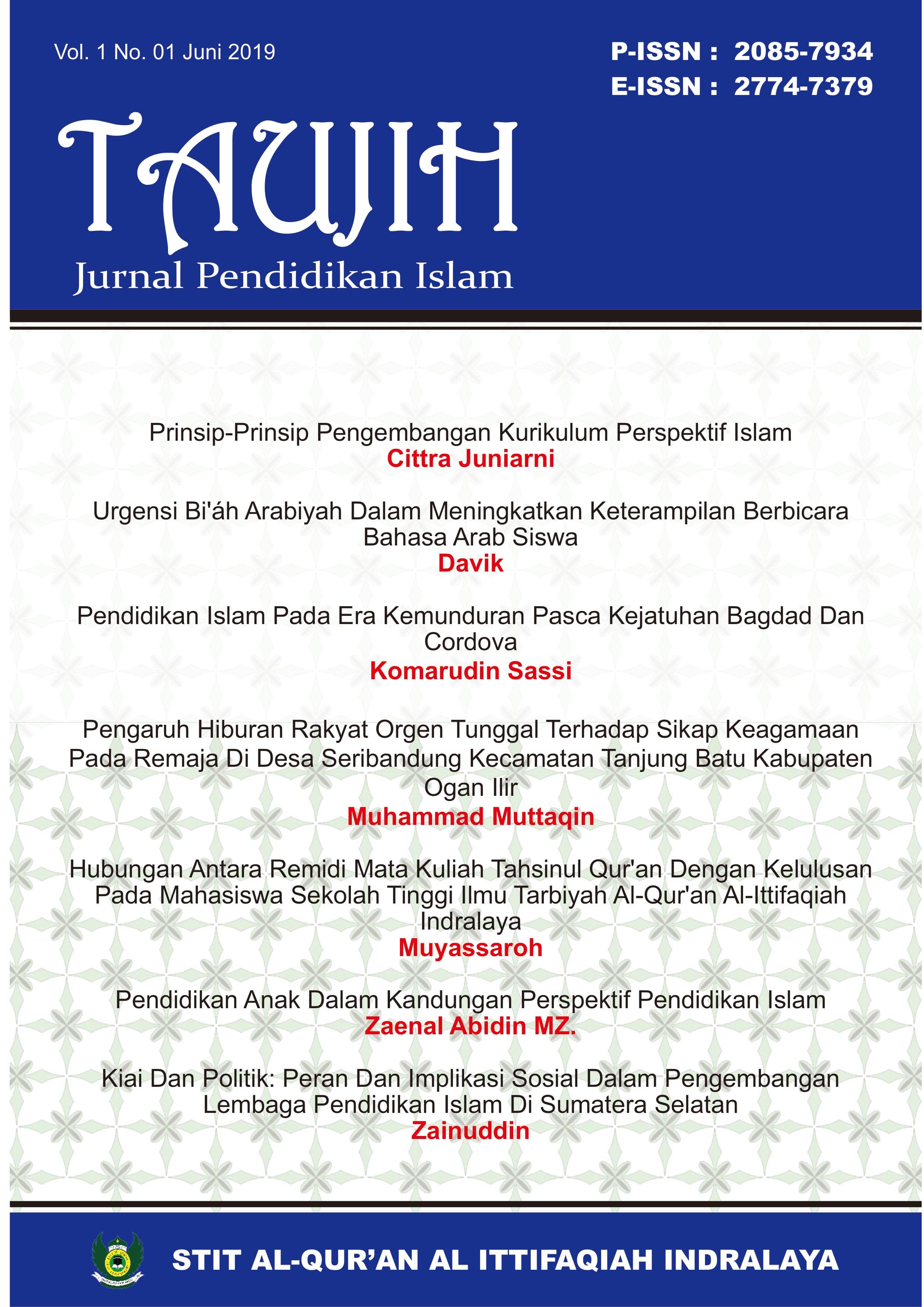
Hukuman Fisik dalam Prespektif Pendidikan Islam dan Penerapannya di Pesantren
DOI:
https://doi.org/10.53649/taujih.v6i01.644Keywords:
Corporal Punishment, Islamic Boarding SchoolAbstract
The aim of this research is to analyze, interpret and evaluate Islamic educational perspectives on corporal punishment and its application in Islamic boarding schools. This research uses a qualitative design approach with research methods: literature study, field research (case study), and evaluation research. Data collection was carried out using literature study methods, interviews, observation and documentation. The data analysis is inductive. Testing the validity of the data is by means of credibility, transferability, dependability and confirmability. The results of this research show that: (1) The perspective of Islamic education regarding the paradigm of corporal punishment is based on the text of the Koran and the Hadith of the Prophet SAW. as well as the opinion of the ulama that Islam allows in educating students to apply physical punishment as a means to awaken and correct students with something that is not painful for their mistakes; (2) As a process of discipline, maintenance and learning, for Islamic boarding schools the application of corporal punishment is not understood as an act of violence; (3) The perspective of Islamic education regarding the application of corporal punishment in Islamic boarding schools is still very relevant. The application of corporal punishment from an Islamic boarding school perspective is an Islamic teaching that is full of meaning and benefits for students in enforcing discipline for students and maintaining order, and does not conflict with human rights principles.
References
Al-Qur???an dan Tarjamah.
al-Fauzan, Syaikh Shaleh al-Fauzan (t.th), Ighatsatul Mustafid Bi Syarh Kitab Tauhid. t.t: Mu???assasah ar-Risalah.
Abdullah, Abdurrahman Saleh. (2015). Teori-teori Pendidikan Berdasarkan Al-Qur???an, terj. M. Arifin dan Zainuddin. Jakarta: Rineka Cipta.
Asy???ari, Hasyim. (1238 H). Adab al-'Alim wa al-Muta'allim.Jombang: Tebuireng.
Dawud, Abu. (2016). Terjemahan Sunan Abu Dawud, terj. Bey Arifin dan A. Syinqithy Djamaluddin. Semarang: T.p.
Dofier, Zamakhsari. (2014). Tradsisi Pesantren: Studi tentang Pandangan Hidup Kyai. Jakarta: LP3ES.
Lincoln, YS and Egon G. Guba. (1985). Naturalistic Inquiry. California: Sage
Publications, Beverly Hill.
Majdjid, Nurcholish. (2017). Bilik-bilik Pesantren: Sebuah Potret Perjalanan. Jakarta: Paramadina.
Neuman, W. Lawrence. (1997). Social Reseach Methodes Qualitative and Quantitative Approaches. London: Allyn & Bacon.
Suparman, Usman. (2016). Hukum Islam. Jakarta:Gaya media pratama.
Strauss, Murray A.. (2015). ???Prevalence, Societal Causes, And Trends in Corporal Punishment By Parents in World Perspective???. Jurnal Law and contemporary Problems. 73, (2), 2.
Sugiyono. (2005). Memahami Penelitian Kualitatif. Bandung: Alfabeta.
Tim Departemen Agama RI. (2019). Pola Pembelajaran di Pesantren. Jakarta: Direktorat Jenderal Kelembagaan Agama Islam.
Tim Penyusun/Redaksi. (2014). Al Mumayyaz: Al-Qur???an Tajwid. Jakarta: Cipta Bagus Segara.
Ulwan, Abdullah Nashih. (2019). Pendidikan Anak Menurut Islam. Bandung: Remaja Rosda
Karya.
Vockel, Edward L. (2019). ???Corporal Punishment The Pros and Cons???. Journal The Clearing House. 64, (3), 278.